
Practise 100 important IAS questions covering Polity, History, Geography, Economy, Environment, Science, Ethics and the Interview, with a smart preparation strategy.
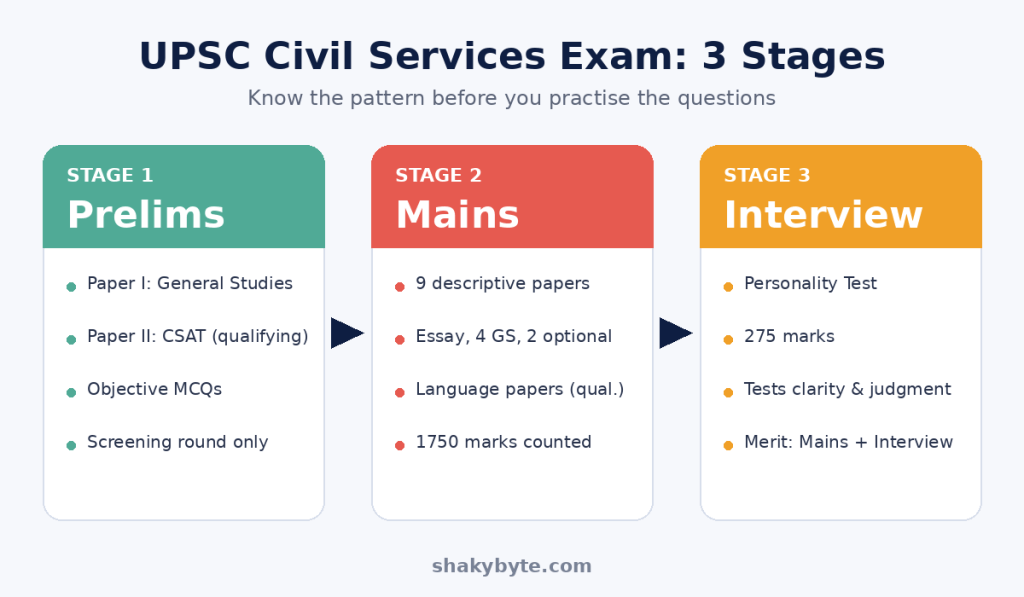
Clearing the UPSC Civil Services Examination takes more than reading thick books. You need to know what kind of questions the exam asks and practise answering them. UPSC repeatedly tests the same core themes: the Constitution, governance, economy, environment, geography, ethics and current affairs.
This article lists 100 important questions across subjects, including 20 personality-test (interview) questions. Use them to find your weak areas, write practice answers and revise smartly.
How to Use This List
- Attempt each question first without looking at notes.
- For Mains-style questions, write a 150-word answer in 7 minutes.
- Mark questions you couldn’t answer and revise those topics.
- Link every static topic to a current example.
Indian Polity and Governance (Questions 1–12)
- What is the Basic Structure doctrine, and which case established it?
- How do Fundamental Rights differ from Directive Principles of State Policy?
- Explain the powers and limitations of the President of India’s ordinance-making power.
- What is the difference between a Money Bill and a Financial Bill?
- How does the anti-defection law work, and what are its criticisms?
- What is the role of the Governor, and why is the office often controversial?
- Discuss the significance of the 73rd and 74th Constitutional Amendments.
- What is judicial review, and how does it protect the Constitution?
- How do Article 356 and the concept of President’s Rule affect federalism?
- What is the difference between a writ of Mandamus and a writ of Certiorari?
- Examine the role of the Election Commission in conducting free and fair elections.
- What is cooperative federalism, and how does the GST Council reflect it?
Indian History and Culture (Questions 13–24)
- What were the main causes and consequences of the Revolt of 1857?
- Compare the contributions of the Moderates and Extremists in the freedom struggle.
- Why did the Non-Cooperation Movement begin, and why was it withdrawn?
- Explain the significance of the Poona Pact.
- What were the key features of the Mauryan administration?
- How did the Bhakti and Sufi movements influence Indian society?
- Describe the main features of Indo-Islamic architecture.
- What were the achievements of the Gupta period, and why is it called a “Golden Age”?
- Discuss the role of Subhas Chandra Bose and the INA in India’s independence.
- Explain the Cabinet Mission Plan and why it failed.
- How did the Permanent Settlement change land revenue in colonial India?
- What are the major classical dance forms of India, and how do they differ?
Geography (Questions 25–36)
- How do monsoon winds form, and why are they unpredictable?
- What causes the formation of cyclones in the Bay of Bengal?
- Explain the importance of the Western Ghats for India’s biodiversity and climate.
- Why do some Indian rivers flood frequently, and what can be done about it?
- What is the significance of the Himalayas to India’s climate and water security?
- Differentiate between weather and climate with examples.
- What are the causes and impacts of El Niño and La Niña on Indian agriculture?
- Why is the Indian Ocean strategically important?
- Explain the distribution of major minerals in India.
- What is plate tectonics, and how does it explain earthquakes and volcanoes?
- How does urbanisation affect water resources in Indian cities?
- What are the reasons for the uneven population distribution across India?
Indian Economy (Questions 37–48)
- What is inflation, and how does the RBI control it?
- Explain the difference between fiscal deficit and revenue deficit.
- What are the objectives and challenges of the Goods and Services Tax?
- What is the role of the Monetary Policy Committee?
- How do subsidies affect the economy, and what is the debate around direct benefit transfers?
- What are Non-Performing Assets, and why are they a concern for banks?
- Discuss the significance of MSMEs for employment and growth.
- What is the difference between GDP, GNP and GVA?
- How has the New Education Policy and skill development affected India’s demographic dividend?
- Explain the concept of Minimum Support Price and its impact on farmers.
- What are the causes of unemployment in India, and how can it be reduced?
- How do Foreign Direct Investment and Foreign Portfolio Investment differ?
Environment and Ecology (Questions 49–56)
- What is sustainable development, and how can India balance growth with conservation?
- Explain the causes and effects of climate change on India.
- What is the role of the National Green Tribunal?
- How do wetlands help the environment, and what is the Ramsar Convention?
- What are the threats to biodiversity hotspots in India?
- Differentiate between in-situ and ex-situ conservation.
- What are the main sources of air pollution in Indian cities, and how can they be controlled?
- What is the significance of the Paris Agreement and India’s climate commitments?
Science and Technology (Questions 57–64)
- What is Artificial Intelligence, and what are its opportunities and risks for governance?
- Explain the importance of India’s space programme for development.
- What is the difference between renewable and non-renewable energy, and why is the energy transition important?
- How is biotechnology used in agriculture and medicine?
- What are the concerns around data privacy and cyber security in India?
- Explain the working and use of the Unified Payments Interface.
- What is nuclear energy’s role in India’s energy mix?
- How do vaccines work, and why is herd immunity important?
International Relations (Questions 65–72)
- What is India’s “Neighbourhood First” policy?
- Explain India’s role in BRICS, the Quad and the SCO.
- How do India–China border tensions affect regional stability?
- What is the significance of the Indo-Pacific region for India?
- Discuss India’s relationship with the United States and Russia in a changing world order.
- What is the role of the United Nations, and why does India seek a permanent Security Council seat?
- How does the Indian diaspora contribute to India’s soft power?
- What are the challenges and opportunities in India’s relations with Bangladesh and Sri Lanka?
Ethics, Integrity and Aptitude (Questions 73–80)
- What is the difference between ethics and morality?
- How would you handle a conflict of interest as a public servant?
- What is emotional intelligence, and why is it important for administrators?
- Explain the importance of probity and transparency in governance.
- What would you do if a senior asked you to act against the rules?
- What is the role of a whistleblower, and how can they be protected?
- How can compassion and empathy improve public service delivery?
- “Law and ethics don’t always align.” Discuss with examples.
Interview (Personality Test) Questions (Questions 81–100)
- Tell us about yourself and why you chose the civil services.
- Why do you want to be an IAS officer and not an IPS or IFS officer?
- What are your strengths and weaknesses?
- What is the biggest challenge facing your home district, and how would you tackle it?
- If you were District Magistrate during a flood, what would be your first three actions?
- What would you do if a politician pressured you to transfer a subordinate?
- How do you handle stress and failure?
- What is your opinion on a current national issue of your choice?
- How would you improve the quality of government schools in rural areas?
- If you do not clear the exam, what is your Plan B?
- How do you think social media has affected governance and public opinion?
- What is the role of women in nation-building, and how can their participation be increased?
- How would you handle corruption in your office?
- What do you understand by good governance?
- Which book or personality has influenced you most, and why?
- How would you balance your personal beliefs with your duty as a civil servant?
- What steps would you take to promote digital literacy in villages?
- Do you think reservation is still needed? Present both sides.
- What is your vision for India in 2047?
- Is there anything you would like to ask us?
Smart Preparation Tips
- Read the syllabus first. Every question should map to a syllabus topic.
- Solve previous years’ papers. Patterns repeat even when wording changes.
- Follow one newspaper daily and make short notes on current affairs.
- Practise answer writing from the first month, not after finishing the syllabus.
- Revise at least three times. Retention beats coverage.
- Take mock tests to build speed and accuracy.
Final Thoughts
No list can predict the exact paper, but these 100 questions cover the concepts, issues and thinking styles that UPSC keeps returning to. Work through them regularly, support your answers with facts and examples, and stay consistent. Good luck with your preparation!
Which subject would you like a full model-answer post for next? Share your thoughts in the comments below.

